


Reviewed for accuracy: July 2026. General information, not medical advice. We manufacture grounding sandals; the evaluation criteria below apply to our product as strictly as anyone's.
Grounding footwear promises to solve the central irony of the whole practice: the same shoes that make walking outdoors comfortable are precisely what insulates you from the ground you're walking on. A conductive shoe or sandal re-opens that connection while you walk. It's a real product category with real physics — and it's also a category with wide quality variance and some honest limitations that a buying guide owes you before any recommendations. Here's how the products work, how the two formats compare, and the checklist that separates functioning grounding footwear from regular sandals with a story.
How grounding footwear works
Ordinary shoe soles — rubber, EVA foam, polyurethane — are insulators; that's most of why modern humans are chronically ungrounded. Grounding footwear builds a conductive path through the sole: typically a conductive plug, rivet, or laminate running from the footbed (contacting your foot, usually at the ball or heel) through to the outsole (contacting the earth). When you stand on a conductive surface — soil, grass, damp sand, unsealed concrete, per our surfaces guide — the path closes and you equalize to earth potential through the shoe. Two consequences follow immediately from the design. First, the surface still matters: grounding sandals on asphalt or a wood deck ground nothing, because the surface itself is the broken link. Second, the path is small: a conductive plug is a modest contact patch compared to a full bare sole, which is why honest brands describe footwear as a partial restoration of barefoot conduction, not its equal.
Sandals vs closed shoes: the real trade-offs
| Grounding sandals | Closed grounding shoes | |
|---|---|---|
| Conduction path | Short and direct — bare or near-bare foot on the conductive footbed, minimal interference | Longer chain: sock and insole sit in the path; conduction depends on sock fiber and moisture (see our fabric-layers guide) |
| Season and setting | Warm-weather and casual use — which is also when conductive surfaces are actually available | Year-round wear, but winter conditions pair them with the season of insulating surfaces and thick socks |
| Failure modes | Fewer parts, easy to inspect the plug visually | Laminate/rivet systems harder to inspect; sock variable reintroduces uncertainty daily |
| Verifiability | Identical for both: a continuity test from footbed contact point to outsole settles whether the path exists — the same thirty-second multimeter check as any grounding product | |
Our engineering read, stated with our bias disclosed: the sandal format is the honest sweet spot of this category, because it minimizes the variables between your skin and the earth in exactly the seasons and settings where grounded surfaces exist. It's the format we chose to build — the Earthbound Grounding Sandals run a conductive path from footbed to sole for exactly the barefoot-adjacent use case above. Closed grounding shoes are a legitimate product for people who need closed footwear; they simply carry more conditions on their performance, and a buyer should know that going in.
The five-point footwear checklist
- A described conduction path. The product page should state how the footbed connects to the outsole — plug, rivet, laminate. "Conductive materials" with no mechanism is a story, not a spec.
- Testability. You should be able to verify continuity yourself. If the brand publishes no test method and includes no way to check, apply the same rule as everywhere in this category: unverifiable means unknown.
- Honest surface framing. A brand that admits its shoes do nothing on asphalt is a brand reporting physics; one that implies all-day city grounding is reporting marketing.
- Actual footwear quality. You'll wear these for hours: strap comfort, sole durability, and fit matter exactly as they do for any sandal, because a grounding sandal you don't wear grounds nothing.
- Return terms that allow wearing them. The recurring theme of this blog's buying advice: a trial that requires the product back unworn isn't a trial. Earthbound's 90-night policy covers the sandals like everything else.
Where footwear fits in an honest grounding practice
Sized accurately: grounding footwear is a daytime supplement that converts walks, yard work, and patio hours into grounded time you'd otherwise lose to rubber soles. It does not replace barefoot contact (a full sole beats a plug), and it cannot approach the contact-hours of sleeping grounded — the eight-hour nightly block the research window is built on. The sensible stack, in order of leverage: the bed pad for the night hours, footwear and a desk mat for the day, barefoot whenever life allows. Footwear's job is closing the daytime gap — and judged by that job instead of inflated ones, good grounding sandals earn their place.
The sandal built to the checklist
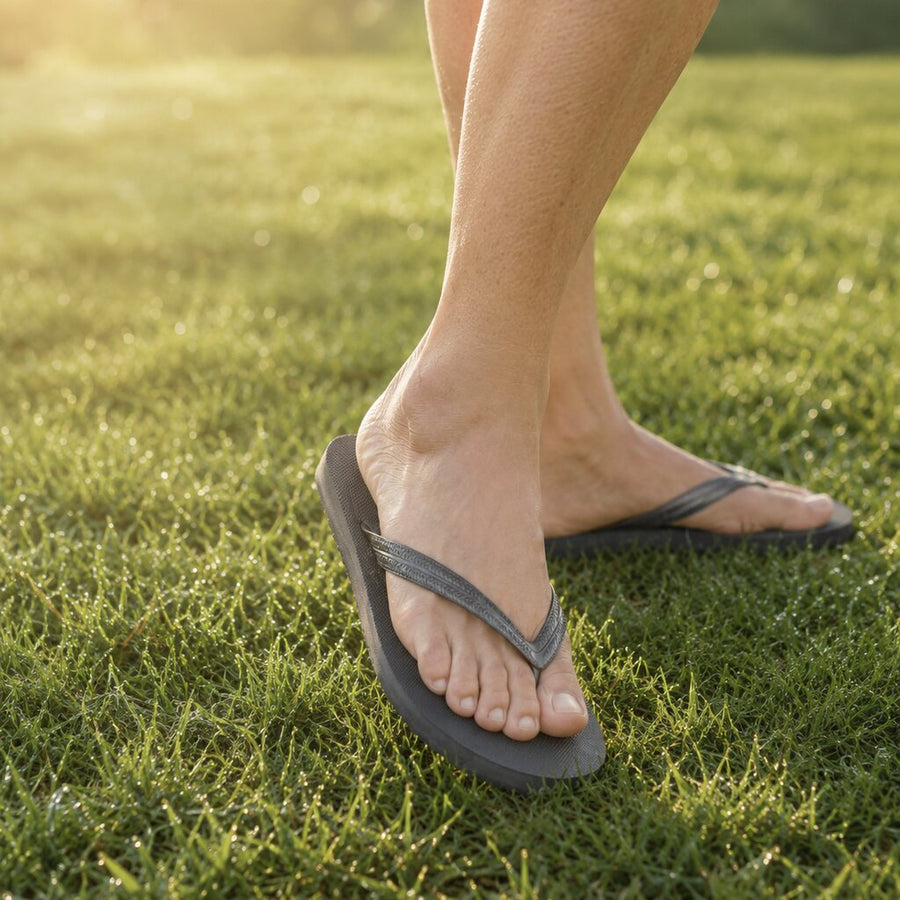
The Earthbound Grounding Sandals: stated footbed-to-sole conductive path, verifiable with a continuity test, honest about surfaces, and covered by the 90-night trial — worn, outdoors, the way footwear actually gets evaluated.
Frequently asked questions
Do grounding shoes actually work?
Ones with a genuine footbed-to-outsole conductive path do — on conductive surfaces (soil, grass, damp sand, unsealed concrete). No grounding footwear works on asphalt, sealed floors, or wood, because the surface breaks the circuit. Continuity is testable with a multimeter.
Are grounding sandals better than grounding shoes?
Sandals carry the shorter, more reliable conduction path — near-bare foot on the conductive footbed — and align with the seasons when grounded surfaces exist. Closed shoes add the sock variable and suit people who need closed footwear.
Can you wear socks with grounding shoes?
Thin natural-fiber socks reduce but may not eliminate conduction; synthetic or thick socks block it. Same fabric physics as grounding through bedding.
How do I test grounding footwear?
Multimeter continuity between the footbed contact point and the outsole plug — the path either exists or it doesn't. Then remember the surface test: even perfect footwear grounds nothing on an insulating surface.
Grounding products are not intended to diagnose, treat, cure, or prevent any disease.