



Reviewed for accuracy: July 2026. General information, not medical advice. The measurement described uses a standard multimeter at safe household signal levels.
Body voltage is the rare wellness-adjacent concept you can hold a meter to, and this article's whole ambition is to have you do exactly that. In the next ten minutes you'll understand what the number is, why it exists, what it honestly does and doesn't tell you about your health, and how to run the measurement on your own body tonight — including watching it collapse toward zero the moment you ground. No belief required at any step; that's the point.
What body voltage actually is
Stand in any wired room and you're standing inside a web of alternating electric fields radiating from the wiring in the walls, the lamp cord, the charger on the nightstand — everything energized at 60 Hz (50 Hz outside North America). Your body is conductive, so those fields induce a small oscillating voltage on it, the same way a transformer induces voltage in a nearby coil. "Body voltage" is that induced AC potential, measured between your body and the earth. Near ordinary bedroom electronics it typically reads anywhere from a few hundred millivolts to several volts; in bed with a charging phone on the nightstand and wiring in the wall behind the headboard, readings of 1–5 V are common. It's capacitive coupling — physics as mundane as static cling — and every human in a modern building carries it.
What the number means — and the honest limits
Two things must be said with equal weight. First: induced body voltage at these levels is not electrocution, not current flowing through you in any harmful sense, and mainstream science has not established that it damages health. Anyone selling terror about your 2.94 V is selling. Second: the measurement is still meaningful for one precise purpose — it's a direct, quantitative indicator of whether your body is electrically coupled to your environment's fields or equalized to the earth. Grounded, you sit at the earth's potential and the induced voltage collapses toward zero; ungrounded, you float at whatever the local fields induce. Whether the grounded state carries the physiological benefits suggested by the pilot literature — cortisol rhythm, inflammatory markers, blood viscosity, reviewed honestly in our evidence article — remains the open research question. But the electrical state itself is not in dispute, and it's yours to observe.
Measure your own body voltage tonight
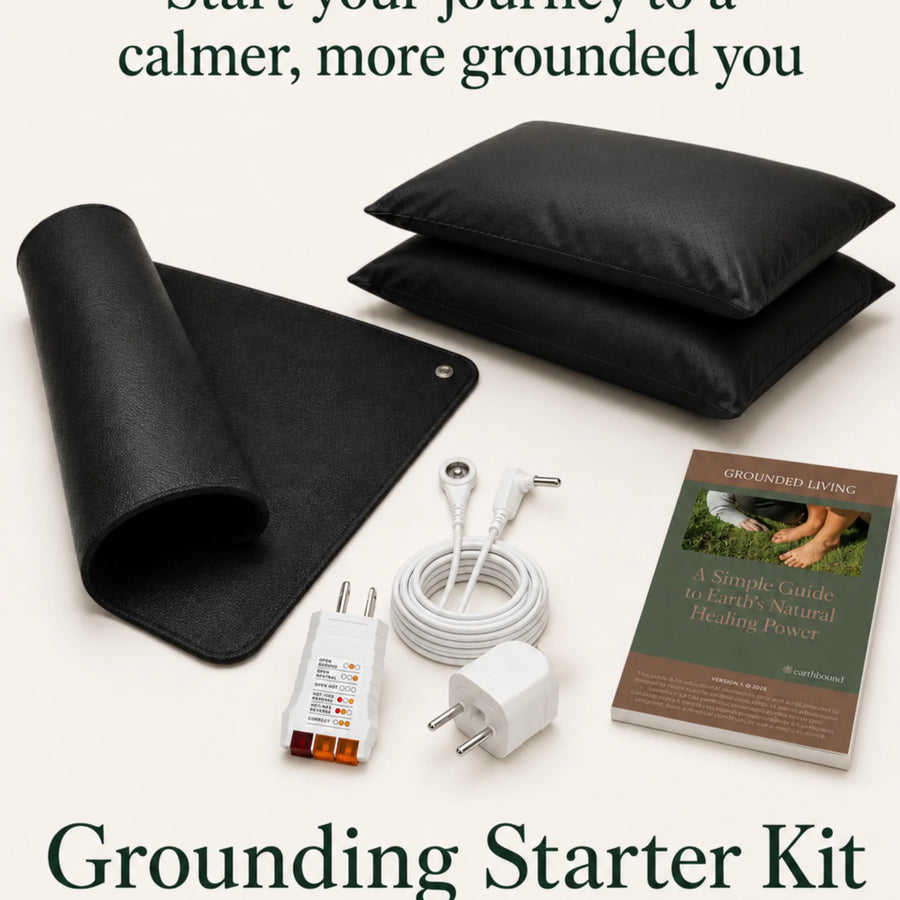
You need a basic digital multimeter (from about $15 at any hardware store) or a grounding test kit — Earthbound includes one free with every pad.
- Set the meter to AC volts (V~), 20 V range if your meter isn't auto-ranging.
- Reference to ground: plug the black probe into the round ground port of a wall outlet — the ground port only. (First verify the outlet's ground is real with an outlet tester; our testing guide covers it.)
- Hold the red probe's metal tip firmly between thumb and finger. The display now shows your body voltage.
- Walk the room. Watch the number climb near the charging phone, the lamp, the wall behind the bed, and fall in the middle of the room. You're mapping your bedroom's fields with your own body as the antenna.
- Now ground yourself — bare feet on a connected grounding mat or a hand on a connected pad — and watch the reading collapse, typically to a few tens of millivolts. That drop, from volts to approximately nothing, is the entire electrical function of every grounding product, performed live on your meter.
This before/after is the demonstration we photograph for our own materials — a multimeter reading dropping from 2.94 V ungrounded to 0.00 V grounded — and the reason we'd rather hand you the instrument than the adjective. It also gives you a permanent audit tool: any grounding product, any brand, any year later, thirty seconds to re-verify.
What to do with the knowledge
Three reasonable responses, in ascending order of commitment. One: nothing — you've learned a genuinely interesting fact about living in wired buildings, and the voltage itself isn't an established harm. Two: cheap field hygiene — move chargers off the nightstand, put distance between the bed and the busiest wall, and watch your bedside reading drop for free. Three: grounding — the only intervention that changes your body's state rather than the field around it, taking you to earth potential for the full eight hours the research timeline cares about. If you run that experiment, run it properly: meter reading on night one, baseline sleep log, and the 90-night window to judge on your own data.
The meter-first grounding product
The Earthbound Grounding Mattress Pad ships with the test kit to run everything on this page — outlet verification, continuity, and your own before/after body voltage. Carbon construction you can re-test for life, 90-night trial. Watch the number drop, then decide.
Frequently asked questions
What is a normal body voltage?
In a wired room, induced AC body voltage commonly measures from a few hundred millivolts to several volts depending on proximity to wiring and devices. It varies by position in the room — which you can map yourself with a multimeter.
Is high body voltage dangerous?
Induced voltage at household levels is not electric shock, and established science has not shown it harms health. It is a measurement of electrical coupling to your environment, not a diagnosis.
What should body voltage be when grounded?
Near zero — typically a few tens of millivolts. The drop from volts to approximately zero on contact is the verifiable electrical function of any working grounding product.
How do I measure my body voltage at home?
Multimeter on AC volts, black probe in the outlet's ground port (verified grounded first), red probe held in your fingers. Read, move around the room, then touch a grounded surface and watch it fall.
Does lowering body voltage improve health?
That's the open research question. Pilot studies on grounding report favorable signals on sleep and inflammatory markers, but they're small; the electrical change is proven, the health effects are promising-not-proven.
Grounding products are not intended to diagnose, treat, cure, or prevent any disease.